1
Part of your transition into higher education involves being aware that each discipline is a distinct discourse community with specific vocabularies, styles, and modes of communication that are used by professionals in the field. The following formal aspects of articles vary according to the discipline they are written for:
- Title format
- Introduction
- Overall organization
- Tone (especially level of formality)
- Person (first, second, or third person)
- Voice (active or passive)
- Sections and subheads
- Use of images (photos, tables, graphics, graphs, etc.)
- Discipline-specific vocabulary
- Types of sources cited
- Use of source information
- Conclusion
- Documentation style
- Intended audience
- Published format (print or online)
Different disciplines also tend to recommend collecting different types of evidence from research sources. For example, biologists are typically required to do laboratory research; art historians often use details from a mix of primary and secondary sources (works of art and art criticism, respectively); social scientists are likely to gather data from a variety of research study reports and direct ethnographic observation, interviews, and fieldwork; and a political scientist uses demographic data from government surveys and opinion polls along with direct quotations from political candidates and party platforms.
What’s required to complete a basic, introductory essay might essentially be the same across all disciplines, but some types of assignments require discipline-specific organizational features. For example, in business disciplines, documents such as résumés, memos, and product descriptions require a specialized organization. Science and engineering students follow specific conventions as they write lab reports and keep notebooks that include their drawings and results of their experiments. Students in the social sciences and the humanities often use specialized formatting to develop research papers, literature reviews, and book reviews.
Scholars also tend to ask discipline-related kinds of questions. For example, the question of “renewable energy” might be a research topic within different disciplines. The following list shows the types of questions that would accommodate the different disciplines:
- Business (economics): Which renewable resources offer economically feasible solutions to energy issues?
- Humanities (history): At what point did humans switch from the use of renewable resources to nonrenewable resources?
- Natural and applied sciences (engineering): How can algae be developed at a pace and in the quantities needed to be a viable main renewable resource?
- Social sciences (geography): Which US states are best suited to being key providers of renewable natural resources?
Exercise 1
1. Based on the example at the end of this section, pick a topic that multiple disciplines study. Formulate four questions about the topic, one from each of any four different disciplines. Ideally choose a topic that might come up in four courses you are currently taking or have recently taken, or choose a topic of particular interest to you. Here are just a few examples to get you started:
- Alcoholism
- Child abuse
- Poverty in developing nations
- Fast food
- Women in the workforce
Even though you will eventually enter a discipline as an academic specialization (major) and as a career path (profession), the first couple of years of college may well be the best opportunity you will ever have to discover how disciplines are connected.
In truth, all disciplines are strikingly similar. As humans, we have designed disciplines, over time, to help us understand our world better. We use academic and professional disciplines to conduct persistent, often unresolved conversations with one another.
Most colleges insist on a “core curriculum” to make sure you have the chance to be exposed to each major discipline at least once before you specialize and concentrate on one in particular. The signature “Aha!” moments of your intellectual journey in college will come every time you grasp a concept or a process in one course that reminds you of something you learned in another course entirely. Ironically the more of those “Aha!” moments you have in the first two years of college, the better you’ll be at your specialization because you’ll have that much more perspective about how the world around you fits together.
How can you learn to make those “Aha!” moments happen on purpose? In each course you take, instead of focusing merely on memorizing content for the purposes of passing an exam or writing an essay that regurgitates your professor’s lecture notes, learn to look for the key questions and controversies that animate the discipline and energize the professions in it. If you organize your understanding of a discipline around such questions and controversies, the details will make more sense to you, and you will find them easier to master.
Exercise 2
1. Arrange at least one interview with at least one of your instructors, a graduate student, or a working professional in a discipline in which you are interested in studying or pursuing as a career. Ask your interviewee(s) to list and describe three of the most persistent controversies, questions, and debates in the field. After absorbing the response(s), write up a report in your own words about the discipline’s great questions.
Articulating Multiple Sides of an Issue
Regardless of the discipline you choose to pursue, you will be arriving on the scene in the middle of an ongoing conversation. Disciplines have complicated histories you can’t be expected to master overnight. But learning to recognize the key terms and topics in individual disciplines can help you make sense of the specific issues, themes, topics, and controversies you will encounter as a student and as a professional.
Learning to think, write, and function in interdisciplinary ways requires practice that begins at the level of close reading and gradually expands into the way you interact with your surroundings as a college student and working professional.
For a model of how to read and think through the disciplines, let’s draw on a short but very famous piece of writing, Abraham Lincoln’s “Address at the Dedication of the Gettysburg National Cemetery,” composed and delivered in November of 1863, several months after one of the bloodiest battles in the American Civil War.
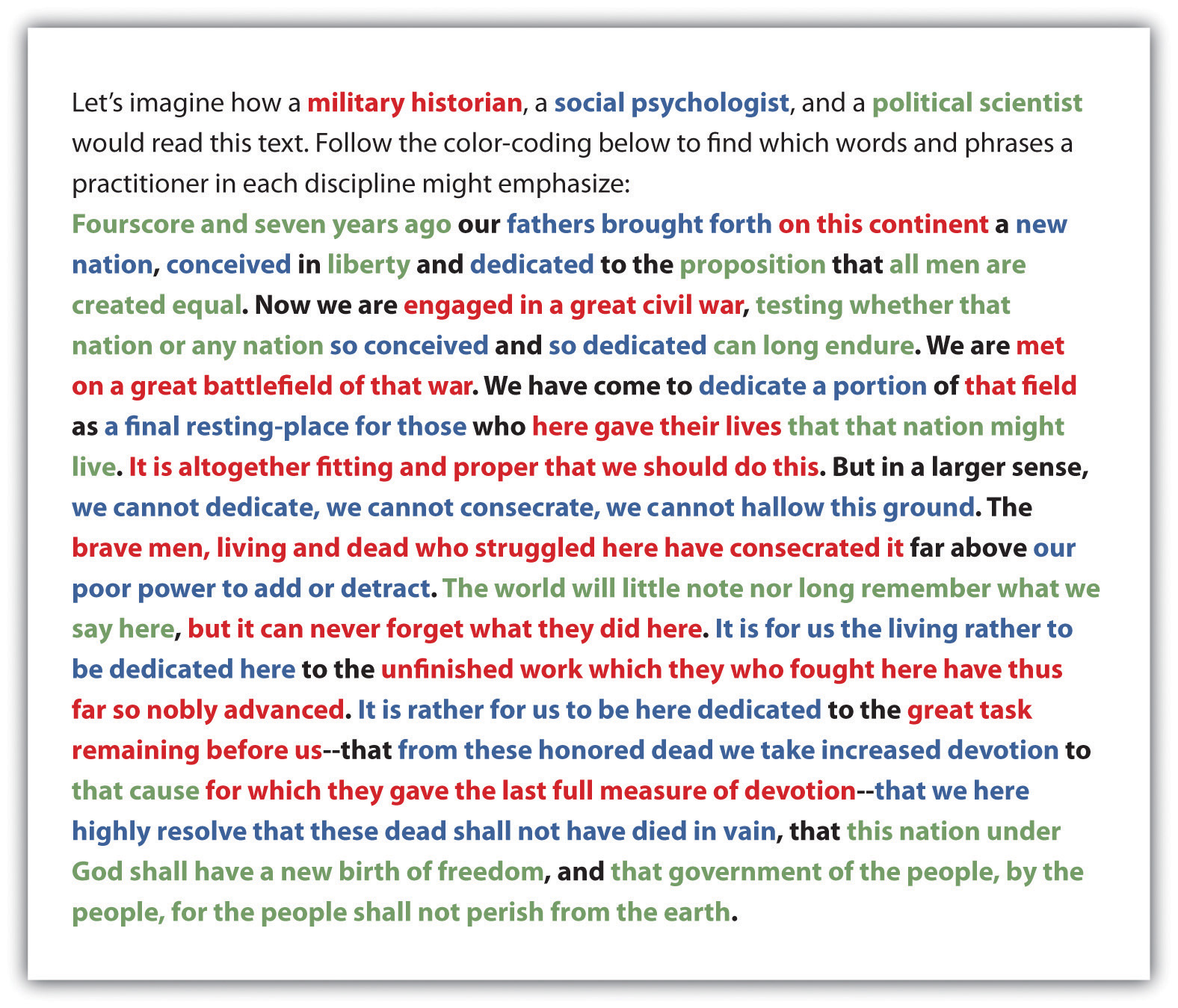
- A military historian (red passages) might focus on Lincoln’s rhetorical technique of using the field of a previous battle in an ongoing war (in this case a victory that nonetheless cost a great deal of casualties on both sides) as inspiration for a renewed, redoubled effort.
- A social psychologist (blue passages) might focus on how Lincoln uses this historical moment of unprecedented national trauma as an occasion for shared grief and shared sacrifice, largely through using the rhetorical technique of an extended metaphor of “conceiving and dedicating” a nation/child whose survival is at stake.
- A political scientist (green passages) might focus on how Lincoln uses the occasion as a rhetorical opportunity to emphasize that the purpose of this grisly and grim war is to preserve the ideals of the founders of the American republic (and perhaps even move them forward through the new language of the final sentence: “of the people, by the people, for the people”).
Notice that each reader has been trained to use a specific disciplinary lens that causes certain passages to rise to prominence and certain insights to emerge. But the real power of disciplines comes when these readers and their readings interact with each other. Imagine how a military historian could use social psychology to enrich an understanding of how a civilian population was motivated to support a war effort. Imagine how a political scientist could use military history to show how a peacetime, postwar governmental policy can trade on the outcome of a battle. Imagine how a social psychologist could use political science to uncover how a traumatized social structure can begin to heal itself through an embrace of shared governance.
As Lincoln would say, “It is altogether fitting and proper that we should do this.”
Exercise 3
1. Find an example in one of your courses where the main discipline appears to be borrowing theories, concepts, or binary oppositions from other disciplines in order to produce new insights and discoveries. (Use your textbook, lecture notes, etc)
2. Briefly describe how an insight or discovery applied past disciplinary knowledge to a new situation or challenge. How might you begin to think about addressing one of the contemporary problems in your chosen discipline?
Writing as a College Student
If you’re like most first-year college students, you’re probably anxious about your first few writing assignments. Transitioning from being a successful high school writer to being a quality college writer can be difficult. You have to adjust to different learning cultures. You have to accept that college writing is different from high school writing and come to understand how it is different.
These students relay a typical range of first-year college experiences:
Emma: I always got As on my high school papers, so I thought I was a good writer until I came to college and had to completely rewrite my first paper to get a C–.
Javier: I received an F on my first college paper because I “did not include one original thought in the whole paper.” I thought I was reporting on information I had researched. I didn’t know that I was supposed to add my own thoughts. Luckily, the professor had a policy to throw out each student’s lowest grade of the semester.
Danyell: The professor in my Comp 101 class said that he didn’t want us turning in anything meaningless or trite. He said that we were to show him that we had critical thought running through our heads and knew how to apply it to the readings we found in our research. I had no idea what he was talking about.
Pat: I dreaded my first college English class since I had never done well in English classes in high school. Writing without grammatical and mechanical errors is a challenge for me, and my high school teachers always gave me low grades on my papers due to all my mistakes. So I was surprised when I got a B+ on my first college paper, and the professor had written, “Great paper! You make a solid argument. Clean up your grammar and mechanics next time and you will get an A!” Suddenly it seemed that there was something more important than grammar and punctuation!
Whatever your feelings about your writing experience, writing in college is sure to be different from what you experienced in high school. The difference between high school and college culture is like the difference between childhood and adulthood. Childhood is a step-by-step learning process. Adulthood is an independent time when you use the information you learned in childhood. In high school culture, you were encouraged to gather knowledge from teachers, counselors, parents, and textbooks. As college students, you will rely on personal assistance from authorities less and less as you learn to analyze texts and information independently. You will be encouraged to collaborate with others, but more to discuss ideas and concepts critically than to secure guidance.
It’s important to understand that no universal description of either high school or college writing exists. High school teachers might concentrate on skills they want their students to have before heading to college: knowing how to analyze (often literary) texts, to develop the details of an idea, and to organize a piece of writing, all with solid mechanics. A college teacher might be more concerned with developing students’ ability to think, discuss, and write on a more abstract, interdisciplinary level. But there are exceptions, and debates rage on about where high school writing ends and college writing begins.
Regardless, thinking with flexibility, depth, awareness, and understanding, as well as focusing on how you think, are some of the core building blocks that make higher education “higher.” These thinking methods coupled with perseverance, independence, originality, and a personal sense of mission are core values of higher education.
Exercise 4
1. Write a brief essay or a journal or blog entry about your personal experience with higher education so far. Consider, especially, what sort of misconceptions you have discovered as you compare your expectations with reality.
Avoiding Sexist and Offensive Language
The rights of women have changed dramatically over the past few decades. Slowly, written English has started to reflect those changes. No longer is it considered appropriate to refer to a “female engineer” or a “male nurse.” It is also unacceptable to refer generically to a doctor as “him,” a teacher as “her,” or a politician as “him.” Such usage is considered to be sexist language. You can use acceptable nonsexist language by using passive voice, using plural formats, eliminating pronouns, switching to direct address, and choosing nonsexist terms whenever possible. An option of last resort is to use “his or her,” “his/her,” “her or his,” or “her/his” or even to alternate “his” and “her” throughout a text, though this path is stylistically awkward and usually unnecessary given the other options available to you.
Using Plural Format
By using plural nouns instead of singular nouns, you can switch from sex-specific singular pronouns to gender-neutral pronouns.
Example 1
Example of sexist language using singular pronoun: A family member who misses a holiday dinner will find he has missed more than the food.
Example of nonsexist language using plural pronoun: Family members who miss holiday dinners will find they have missed more than the food.
Revising to Eliminate Pronouns
Since English includes many singular gender-specific pronouns, another way to eliminate sexist language is to eliminate the use of pronouns.
Example 2
Example of sexist language using singular pronoun: A family member who misses a holiday dinner will find he has missed more than the food.
Example of nonsexist language due to elimination of pronoun: A family member who misses a holiday dinner misses more than the food.
Using Direct Address
Sometimes you can simply switch from third-person singular to second-person singular or plural and in the process make your tone more engaging.
Example 3
Example of sexist language using third-person pronoun: A student who forgets to bring his book to class will be assessed a ten-point penalty for his daily work.
Example of nonsexist language using second-person pronoun: If you forget to bring your book to class, you will be assessed a ten-point penalty for your daily work.
Choosing Nonsexist Terms
One of the best methods of solving the sexist language problem is to choose nonsexist terms. With a little practice, you can learn to naturally use the currently preferred nonsexist language rather than terms that are no longer acceptable. Study the following table for some examples.
| Formerly Acceptable | Currently Acceptable |
|---|---|
| businessman, businesswoman | businessperson, business executive |
| chairman, chairwoman | chairperson, chair, head, leader |
| congressman, congresswoman | congressperson, legislator, member of Congress |
| fireman | firefighter |
| mailman | mail carrier, mail delivery person, letter carrier, postal worker |
| man, mankind | humankind, humans, people, Homo sapiens, humanity, the human race |
| policeman, policewoman | police officer, officer of the law, trooper |
| salesman | sales associate, salesperson, seller, vendor |
Avoiding Other Offensive Language
Whether language is offensive depends entirely on the audience. If the audience or part of the audience views the wording as offensive, then the wording is offensive. To avoid inadvertent offensive text, adhere to the following general guidelines.
- Use currently accepted terminology when referencing groups of people. If you are writing about a group of people and you are unsure of the proper terminology, research the most recent usage patterns before you write.
- Be sensitive when referencing people with disabilities by using a “people-first” approach. For example, say “a person who uses a wheelchair” instead of “a wheelchair-bound person.”
- Do not use profanity or vulgar words of any kind. When in doubt, don’t use the term, or if you must use it as part of a quotation, make clear that you’re quoting it.
- Avoid stereotyping (ascribing positive or negative attributes to people based on groups to which they belong).
Exercise 5
1. Rewrite each of the following sentences three times to eliminate the sexist language using the techniques discussed in this section
- When the customer uses abusive language, he can be thrown out of the restaurant.
- A student who habitually arrives late for class is endangering his chances for success.
- There’s nothing more important to elementary education than a teacher who is committed to her students.
2. Over the course of a week, record any instances of stereotypes or any shorthand characterizations of groups of people. Share your list with other members of your group or the class as a whole.
Attributions
- Content adapted from “Exploring Academic Disciplines” licensed under CC BY NC SA 3.0.
- Content adapted from “Seeing and Making Connections” licensed under CC BY NC SA 3.0.
- Content adapted from “Articulating Multiple Sides of an Issue” licensed under CC BY NC SA 3.0.
- Content adapted from “Avoiding Sexist and Offending Language” licensed under CC BY NC SA 3.0.